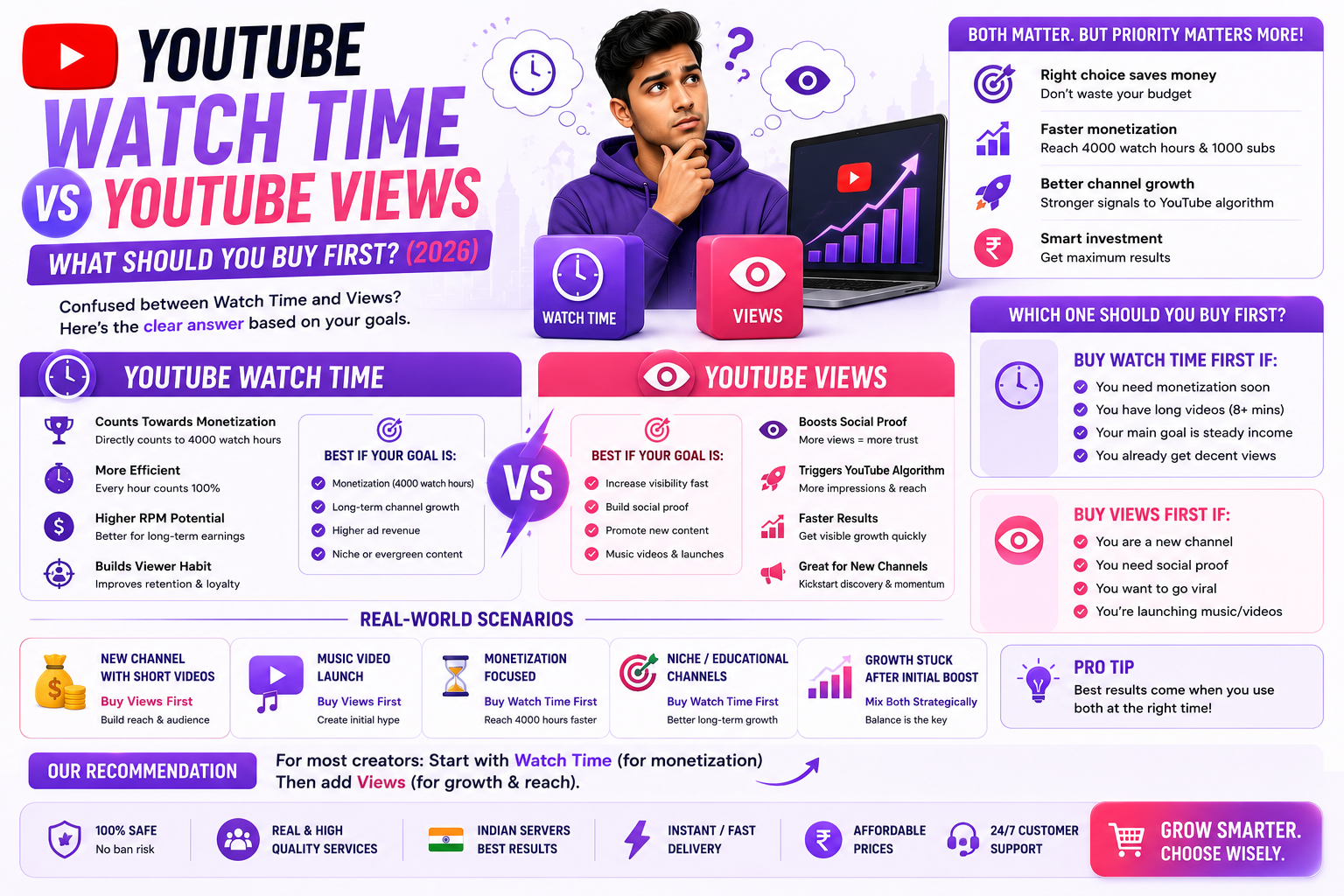
YouTube Watch Time vs YouTube Views: What Should You Buy First? (2026)
This is one of the most common questions Indian YouTube creators ask when they start using an SMM panel: should I buy watch hours or views? The answer changes depending on your specific situation — and buying the wrong one first is one of the easiest ways to waste SMM panel budget.
This guide gives you a clear decision framework. It explains what each metric actually does, how they overlap, the key situations where watch hours should come first, the key situations where views should come first, and the specific scenarios — monetization timing, social proof needs, algorithm signals, music video launches — that should determine your priority.
First: Understanding the Relationship Between Views and Watch Hours
Before comparing them, it is important to understand that views and watch hours are not independent metrics. They are deeply connected.
Every view generates watch hours. When someone watches your 15-minute video for 7.5 minutes (50% retention), that single view generates 7.5 minutes of watch time. When 10,000 people watch that video at 50% retention, you have generated 75,000 minutes (1,250 hours) of watch time from those 10,000 views.
This means:
- Buying high-retention views also increases your watch hours — just less efficiently than buying dedicated watch hours
- Dedicated watch hours are more efficient per rupee for the monetization threshold — because every hour delivered is a full hour, without depending on retention rate
- Views are more efficient per rupee for social proof and algorithm signals — because 10,000 views at 50% retention on a 10-minute video generates a different kind of algorithmic signal than 833 hours of direct watch time
Understanding this relationship is the foundation of the decision framework below.
What YouTube Views Do (Specifically)
Algorithm signal: Views are the primary input for YouTube's initial evaluation of a video. When you upload a video, YouTube shows it to a test audience and measures Click-Through Rate (CTR) from that audience plus Average View Duration (AVD). Views are what makes this test happen — without views, there is no algorithm evaluation.
Social proof: The view count displayed below your video title is a human psychology trigger. Higher view counts drive more organic clicks from new visitors who discover your video through search or recommendations.
Watch hour contribution: As explained above, views with good retention also contribute to watch hours — just at a rate determined by video length × retention rate.
What views do NOT do directly: Views do not directly improve your YouTube search ranking (AVD and CTR are the search ranking factors), and views on their own do not count toward the 4,000-hour YPP requirement unless they have watch duration attached.
What YouTube Watch Hours Do (Specifically)
Monetization threshold progress: Watch hours directly count toward the 4,000 valid public watch hours required for full YouTube Partner Program eligibility. This is their primary purpose. Every hour delivered by a watch hours panel adds directly to your monetization counter.
Algorithm signal (AVD): When viewers watch a long portion of your video, this improves your Average View Duration metric — one of the strongest signals in YouTube's recommendation algorithm. Dedicated watch hours delivery, when done with high-retention sessions, improves your AVD and makes YouTube more confident about recommending your content.
What watch hours do NOT do directly: Watch hours do not improve your video's visible view count (the number shown below your video title), do not improve social proof for human visitors, and do not trigger the initial algorithm test phase (that requires views arriving at the video). Watch hours also do NOT count toward the Shorts-specific monetization threshold (that uses 3M/10M Shorts views separately).
The Key Insight: Which Is More Efficient Per Rupee
Here is the efficiency comparison that resolves most buying decisions:
For reaching the 4,000-hour monetization threshold:Dedicated watch hours delivery is more efficient per rupee than views. Here is why:
A watch hours panel delivers 1,000 hours directly. Cost: approximately ₹80 to ₹120 per 1,000 hours.
To generate 1,000 hours through views on a 15-minute video at 50% retention, you need approximately 8,000 views generating 7.5 minutes each. Cost for 8,000 quality views: approximately ₹600 to ₹1,000.
For the same 1,000 hours: watch hours panel = ₹80 to ₹120 vs views = ₹600 to ₹1,000. Watch hours are 5 to 8 times more efficient per rupee for reaching the monetization threshold.
For algorithm signals and social proof:Views are more efficient per rupee. Here is why:
10,000 quality views on your video at ₹150 per 1,000 = ₹1,500. This creates: a visible view count of 10,000 (social proof), CTR improvement from the social proof effect, 750 hours of watch time (at 50% retention on a 15-minute video), and an algorithm test with meaningful data.
To generate the same 750 hours through a watch hours panel: ₹60 to ₹90 — but with no view count increase, no social proof effect, and no initial algorithm test trigger.
Conclusion: Watch hours panels are more efficient for the monetization threshold. Views panels are more efficient for social proof and algorithm visibility. They serve different primary purposes.
The Decision Framework: 6 Scenarios
Scenario 1: You Are Trying to Hit the 4,000-Hour Monetization Threshold
→ Buy watch hours first
This is the clearest case. If your goal is crossing the 4,000-hour YPP threshold, dedicated watch hours delivery is 5 to 8 times more efficient per rupee than views for achieving this specific goal. Every rupee you spend on views instead of watch hours is buying you 5 to 8 times less progress toward monetization.
See our YouTube Watch Hours Panel for current packages structured specifically around the 4,000-hour goal.
Exception: If your watch hours are healthy (above 3,000 hours) but your subscriber count is below 1,000, spend on subscribers first — both thresholds must be met simultaneously for YPP eligibility.
Scenario 2: Your Channel Is Stuck in the Algorithm Sandbox (Very Low Views Per Video)
→ Buy views first
If your videos are getting under 200 views each despite consistent uploading for 2 to 3 months, your channel is stuck in the algorithm sandbox — YouTube has no data about your content because almost nobody is watching it. In this state, buying watch hours on videos with 50 views changes your watch hour count but does not give YouTube the algorithm test data it needs to start recommending your content.
Views break the sandbox by giving YouTube a real audience to evaluate. Once your videos have 1,000 to 5,000 views each and YouTube has engagement data (CTR, AVD), it can start recommending your content organically. After breaking the sandbox with views, you can layer in watch hours more efficiently.
Scenario 3: You Are a Music Artist Launching a New Song
→ Buy views first, overwhelmingly
For music artists — Punjabi singers, Hindi artists, independent producers — the view count is the commercial signal. Nobody in the music industry looks at your watch hours. Labels, managers, playlist editors, and brand teams look at views.
Additionally, music videos typically generate good natural retention because people listen to the full song — so each view comes with reasonable watch time attached anyway. The social proof function of the view count is your primary need. Views first, always.
Scenario 4: You Are a Tutorial Creator with Good Views but Slow Watch Hour Accumulation
→ Buy watch hours first
If your tutorial or educational channel is generating 300 to 500 views per video but accumulating watch hours slowly toward the 4,000-hour threshold, your videos are working (they're getting views and people are watching) but the monetization timeline is stretched. In this scenario, a targeted watch hours order on your highest-quality existing videos accelerates the monetization timeline without needing to boost your view count further.
Scenario 5: Your 12-Month Watch Hours Window Is About to Expire
→ Buy watch hours immediately, urgently
If your rolling 12-month watch hours (check YouTube Studio → Earn → YPP progress, not your all-time total) are declining because old hours are expiring faster than you are earning new ones, a watch hours order is an emergency purchase. Old hours expiring means every day of inaction sets you back. Views would also generate watch time but at 5 to 8x lower efficiency — you don't have time to use views when hours are actively expiring.
Scenario 6: You Need to Improve a Specific Video's Performance in Recommendations
→ Buy views first (with good retention)
If you have a specific video that is not getting recommended despite having good content, the problem is usually that YouTube has not received enough engagement data to confidently recommend it. A views order gives YouTube more data points — the test audience becomes larger, and if the content is genuinely good (high organic retention from real viewers), the expanded test increases the chance of broader recommendation distribution.
Watch hours delivery on the same video would not improve its recommendation performance as directly, because the recommendation algorithm responds to the combination of views + retention signals, not watch hours in isolation.
The Combined Strategy: When to Buy Both
For Indian creators who are serious about channel growth, the most effective approach combines both services — but in the right sequence.
Phase 1 (New channel, under 2,000 watch hours):Views first. Break the algorithm sandbox, establish social proof, generate organic algorithm data. The watch hours that come with these views also move you toward the threshold.
Phase 2 (Established channel, 2,000 to 3,500 watch hours):Views for specific important videos, plus targeted watch hours orders to accelerate the final stretch toward 4,000 hours. The combination of improved view performance and direct watch hour accumulation creates the fastest path.
Phase 3 (Close to threshold, 3,500 to 4,000 watch hours):Watch hours only — the most efficient use of budget to close the final gap. At this stage, you are within weeks of monetization eligibility. Every rupee should go toward the most efficient delivery of the remaining hours.
The Rupee Decision Calculator
Here is a simple calculator to determine your optimal allocation for a ₹1,000 budget:
If you have under 1,000 watch hours: 100% views (₹1,000 on Indian-targeted views). Break the sandbox first.
If you have 1,000 to 2,500 watch hours: 60% views (₹600), 40% watch hours (₹400). Build algorithm momentum while adding hours.
If you have 2,500 to 3,500 watch hours: 30% views (₹300), 70% watch hours (₹700). Accelerate toward the threshold.
If you have 3,500 to 4,000 watch hours: 100% watch hours (₹1,000). Close the gap as efficiently as possible.
If you are a music artist at any watch hour level: 100% views for social proof.
If you are a Shorts-first creator: Views and Shorts views only — Shorts hours count separately toward the 10M Shorts views threshold, not the 4,000-hour threshold.
Where to Order Each Service on TrueSMMPanel
👉 YouTube Watch Hours Panel — For monetization threshold targeting, high-retention delivery, UPI and Paytm payment
👉 YouTube Views SMM Panel — For social proof, algorithm sandbox breaking, Indian-targeted views with UPI and Paytm payment
Frequently Asked Questions
Do views count toward the 4,000-hour watch time requirement?Yes, but only the watch time component of each view. A view on a 10-minute video at 50% average view duration generates 5 minutes of watch time. Views from a panel that have high completion rate also contribute watch hours. Dedicated watch hours are simply more efficient at accumulating hours per rupee because every hour delivered counts fully.
If I buy watch hours, does my view count also increase?No. Watch hours delivery adds to your channel's watch time total but does not change the view count displayed on your videos. Views and watch hours are separate metrics that are both visible in YouTube Studio analytics.
Which contributes more to YouTube search ranking — views or watch hours?Average View Duration (AVD), which is derived from watch time per view, is a stronger search ranking factor than raw view count. However, you cannot improve AVD by buying watch hours without views — AVD requires views to generate. High-retention views improve both view count AND AVD simultaneously, which is why they are more efficient for algorithm signals than watch hours alone.
Can I use both services at the same time?Yes. Running a views order and a watch hours order simultaneously on the same or different videos is fine. The services operate independently and do not interfere with each other.
Related Reading
- YouTube Watch Hours Panel — Current packages and pricing for watch hours delivery
- Cheap YouTube Views SMM Panel — Current Indian-targeted views packages
- How Long Does It Take to Get 4000 Watch Hours: Organic vs SMM Panel — Complete timeline comparison
- Cheapest Way to Get 4000 Watch Hours on YouTube in India — Full cost comparison across all methods
Last updated July 2026. YouTube's algorithm signals and YPP requirements are subject to change.