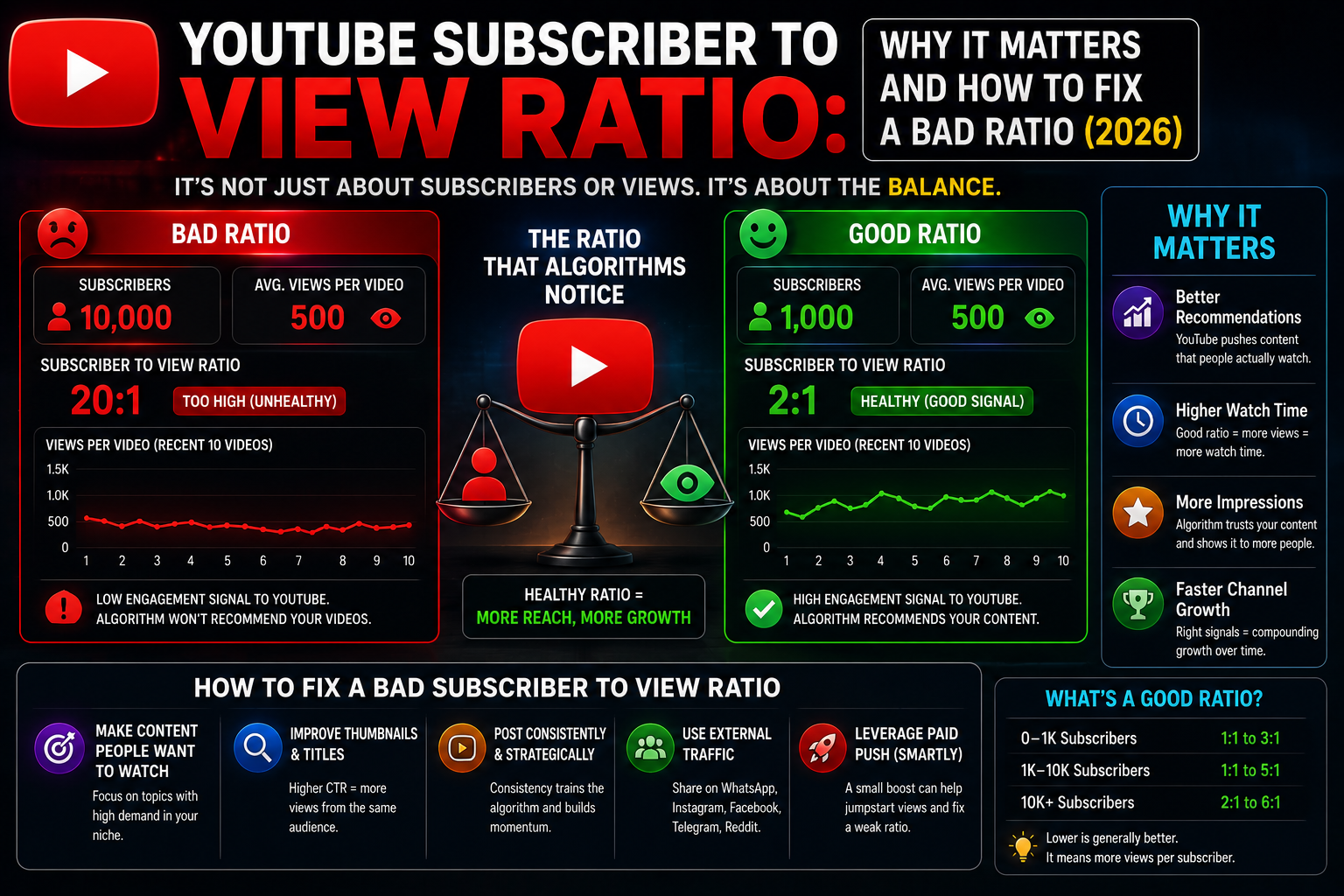
YouTube Subscriber to View Ratio: Why It Matters and How to Fix a Bad Ratio (2026)
Most YouTube creators obsess over two numbers: subscribers and views. What they miss is the relationship between those two numbers — the subscriber-to-view ratio — which is arguably more important to YouTube's algorithm than either metric on its own.
A channel with 10,000 subscribers and 500 views per video is telling YouTube a very different story than a channel with 1,000 subscribers and 500 views per video. One of them looks healthy. The other looks like something has gone badly wrong. Understanding which story your numbers are telling, why it matters, and how to fix a bad ratio is the subject of this guide.
What Is the Subscriber-to-View Ratio?
The subscriber-to-view ratio is simply the percentage of your total subscribers who watch each video you publish.
Formula: (Views per video ÷ Total subscribers) × 100 = Your ratio percentage
Example: If you have 2,000 subscribers and your videos average 200 views each, your ratio is 10%.
This ratio is not a number YouTube publicly displays anywhere. You have to calculate it yourself, and most creators never do — which is why many channels are suffering from a ratio problem without knowing it.
What Is a Healthy Subscriber-to-View Ratio?
There is no universal perfect number, but here is the realistic benchmark range for 2026:
Ratio What It Signals
Above 30% Exceptional — highly engaged, loyal audience
15% to 30% Strong — algorithm will actively recommend your content
10% to 15%Healthy — normal for established channels
5% to 10%Below average — some audience disengagement
Under 5%Problematic — algorithm significantly reduces distribution
Under 2%Very problematic — may be suppressing your channel
These benchmarks also shift depending on channel size. Larger channels (100,000+ subscribers) tend to have lower ratios naturally because the subscriber base becomes harder to reach consistently. Smaller channels (under 10,000 subscribers) should aim for the higher end of this range.
For Indian creators specifically, the expected ratio also varies by content type. Hindi tutorial channels with loyal recurring viewers often see 15 to 25 percent ratios. Entertainment and music channels typically see 5 to 12 percent because their subscribers tend to be more casual, dipping in and out rather than watching every upload.
Why This Ratio Matters So Much to YouTube's Algorithm
Here is the mechanism that most guides never explain clearly.
YouTube's recommendation system evaluates channels partly by how well they retain their subscriber base. When you publish a new video, YouTube does not immediately show it to millions of people. It first shows it to a sample of your subscribers — people who have already said "I want more content from this creator." It then measures how that subscriber audience responds.
If a strong percentage of your subscribers click, watch, and engage — YouTube reads this as: "This creator's subscribers love this content, we should show it to people similar to these subscribers." Distribution expands.
If a weak percentage of your subscribers respond — YouTube reads this as: "Even the people who explicitly subscribed to this channel are not watching. This content is not worth distributing widely." Distribution contracts.
This is why a channel with 500 engaged subscribers can sometimes get more recommendations than a channel with 10,000 disengaged subscribers. The algorithm rewards engagement rate within the existing subscriber base, not raw subscriber count.
For Indian creators, this has a specific implication: buying a large number of low-quality bot subscribers that never watch your videos does not help your channel grow. It actively suppresses growth by making your subscriber-to-view ratio look terrible to YouTube's system.
Two Types of Bad Ratio (Most Guides Only Cover One)
Almost every article on this topic only discusses the problem of "too many subscribers, too few views" — typically caused by bought bot subscribers. But there are actually two completely distinct bad ratio situations, and they have different causes and different fixes.
Type 1: Too Many Subscribers, Too Few Views
Symptom: Your subscriber count is high relative to your views. Example: 8,000 subscribers, 80 views per video (1% ratio).
What causes this:
- Bought bot subscribers that never watch anything
- A viral video or viral Shorts clip that drove mass subscriptions from people who had no long-term interest in your content
- A niche switch — you started as a gaming channel, switched to cooking, and the gaming subscribers never engaged with cooking content
- Subscribers who subscribed years ago and have since become inactive on YouTube entirely
What this does to your channel: YouTube's algorithm sees thousands of people who should theoretically be watching your videos — and are not. It interprets this as your content failing to deliver on its promise. Recommendation frequency drops significantly.
Type 2: Too Few Subscribers, Many Views
Symptom: Your videos get decent views but almost nobody subscribes. Example: 200 subscribers but videos averaging 3,000 views each (150% view-to-subscriber ratio — excellent, but suggests low subscription conversion).
What causes this:
- Search-driven traffic from people who watch one video and leave without subscribing
- Trending content that attracts one-time visitors
- Not asking for subscriptions clearly
- No clear channel identity that makes someone want to subscribe for future content
What this does to your channel: This is actually a healthier problem than Type 1 because your views are real, but you are leaving subscriber growth on the table. Your ratio looks fine to the algorithm (high views relative to subscriber count is not penalized) but you are not converting viewers into the loyal audience that would push your ratio even higher over time.
Most Indian creators with bad ratios have Type 1 — usually caused by either a viral moment that attracted the wrong audience or (more commonly in 2026) by buying low-quality subscribers from bot-based panels.
The Most Common Causes of Bad Ratio for Indian Creators Specifically
Cause 1: Viral Shorts Subscriber Spike
YouTube Shorts can go viral and drive thousands of subscriptions in days — but the people who subscribed after watching a 30-second Short often have very different expectations from your long-form content. A Hindi comedy Short goes viral, 5,000 people subscribe, but your channel's actual content is long-form educational tutorials. The 5,000 Short subscribers almost never watch your tutorials. Ratio collapses.
The fix: Align your Shorts content with your long-form content. Create Shorts that preview or tease your tutorials, not standalone entertainment. Subscribers who come in through a Short that represents your actual content will watch more of it.
Cause 2: Content Niche Switch
Many Indian creators start with one niche (gaming, tech reviews, travel) and switch to another. The existing subscribers stay on the channel because they forgot to unsubscribe — but they never watch the new content. This is extremely common in India where creators often pivot based on trending topics.
The fix: When switching niches, accept that some subscriber loss is unavoidable and beneficial. In YouTube Studio, you can post a community update telling your existing audience about the change — give them a reason to stay or encourage them to move on. A smaller but more relevant subscriber base is better for your ratio than a large disengaged one.
Cause 3: Bought Bot Subscribers (The Worst Ratio Damage)
This is the most severe cause. If you bought 5,000 subscribers from a bot-based panel, those accounts never open YouTube, never click notifications, and never watch a single video. Your subscriber count shows 5,000 but your view-per-video never moves. The ratio damage is immediate and lasting until those bot accounts get swept by YouTube's quality system.
The fix: Stop buying bot subscribers entirely. Allow YouTube's periodic sweeps to remove the bot accounts over time. Simultaneously boost your view count on recent videos to improve the ratio while the sweep clears inactive accounts. Our YouTube Views SMM Panel can help improve the view side of the ratio while your subscriber base naturally cleans up.
Cause 4: Inactive Old Subscribers
Channels that have been active for 2 to 5 years accumulate subscribers who were once active but have since stopped using YouTube regularly, changed interests, or simply forgotten they subscribed. These accounts remain in your subscriber count and depress your ratio without being bots.
The fix: There is no way to remove organic old subscribers — and you should not want to. The fix is generating more compelling content that re-engages dormant subscribers. A well-crafted email-style community post ("We're back with something you'll actually want to watch") can reactivate a percentage of dormant subscribers if your content genuinely delivers on the promise.
How to Calculate Your Ratio Right Now
- Go to YouTube Studio → Dashboard. Note your total subscriber count.
- Go to Analytics → Content → look at your last 10 uploaded videos. Note the average view count across those 10 videos.
- Divide average views by subscriber count and multiply by 100.
Example:
- 3,200 subscribers
- Last 10 videos average 160 views each
- 160 ÷ 3,200 × 100 = 5% ratio
Based on the benchmark table: below average, needs improvement.
Do this calculation once a month to track whether your ratio is improving or worsening. It is more meaningful than watching your raw subscriber count in isolation.
How to Fix a Bad Type 1 Ratio (Too Many Subs, Too Few Views)
These fixes work in combination — none of them alone will fix a severely broken ratio.
Fix 1: Boost your view count on recent videosThis is the fastest lever available. Getting more views on your existing videos immediately improves the numerator of your ratio without waiting for subscriber changes. For Indian creators, a combination of WhatsApp sharing (free) and a targeted views order from a quality panel addresses this quickly.
Fix 2: Improve your notification open rateMost subscribers never click the bell notification, which means they depend on YouTube's browse feed to discover your new videos. Make your thumbnails so compelling that when a subscriber sees your video in their browse feed, they cannot help but click. Thumbnail quality directly affects how many of your subscribers see and engage with your content.
Fix 3: Publish shorter, hook-heavy content temporarilyIf your subscriber base has high drop-off, shorter videos (8 to 10 minutes) with a very strong hook in the first 30 seconds can re-engage dormant subscribers. Once a subscriber watches one video again, YouTube's system re-learns that this subscriber is interested and will show them your future content more often in their feed.
Fix 4: Wait out YouTube's subscriber sweep (for bot subscribers)YouTube runs periodic quality sweeps that remove bot and inactive accounts. If your bad ratio is caused by previously bought bot subscribers, allowing time for the sweep to clean your subscriber list while simultaneously improving view counts is the most sustainable long-term approach.
Fix 5: If you use a subscriber panel going forward — always pair it with a view boostFor any future subscriber order, match the subscriber quantity with a corresponding view boost. Adding 500 subscribers should be paired with adding 1,500 to 3,000 views across recent videos to maintain a healthy ratio. See our YouTube Subscribers Panel for subscriber options and our YouTube Views Panel for the view complement.
How to Fix a Bad Type 2 Ratio (Many Views, Low Subscriber Conversion)
Fix 1: Add a clear, specific subscribe ask after delivering value"If this saved you 2 hours of research, subscribing means more of this every week" converts far better than "please subscribe like and share."
Fix 2: Create a dedicated channel trailerA 60 to 90-second video pinned at the top of your channel page that answers: who is this channel for, what will they learn, why should they subscribe. This converts browse visitors into subscribers.
Fix 3: Build a content seriesInstead of standalone videos, create a series where each video naturally leads to the next. "Part 2 is coming next week" gives viewers a reason to subscribe rather than bookmark.
Fix 4: End screens with subscription promptsYouTube allows you to add an interactive subscribe button in the last 20 seconds of every video. Use it consistently.
Frequently Asked Questions
What is a good subscriber-to-view ratio for an Indian YouTube channel?For most Indian channels, a ratio of 10 to 20 percent per video is healthy. Hindi tutorial and education channels should aim for 15 to 25 percent. Entertainment and music channels typically land in the 5 to 12 percent range due to the more casual nature of that audience.
If I have 1,000 subscribers, how many views per video is healthy?At 1,000 subscribers, a healthy ratio means 100 to 200 views per video minimum. Below 50 views per video on a 1,000-subscriber channel signals a significant engagement problem.
Can a bad subscriber-to-view ratio get my channel penalized?YouTube does not issue formal penalties for bad ratios. The impact is algorithmic — the recommendation system shows your content to fewer people outside your subscriber base, slowing organic growth. It is a suppression effect, not a penalty.
How long does it take to fix a bad ratio?With a combination of view count improvement and consistent quality content, a measurable ratio improvement typically takes 4 to 8 weeks. Complete repair from severely bot-inflated subscriber counts (pending YouTube sweeps) can take 2 to 3 months.
Is it okay to buy subscribers if I also buy views to maintain the ratio?This is exactly the right approach when using a subscriber panel. Buying subscribers without corresponding view support creates ratio damage. Buying both together — subscribers plus views in a realistic ratio — maintains channel health signals. Always aim for your view order to be 3 to 5 times your subscriber order quantity.
Related Reading
- YouTube Subscribers SMM Panel India — Non-drop subscriber delivery with UPI and Paytm payment
- Cheap YouTube Views SMM Panel — Views to complement subscriber orders and maintain healthy ratios
- Buy YouTube Subscribers India: Real vs Fake — How to identify quality subscriber delivery before ordering
- How to Get 1000 YouTube Subscribers Fast in India — Complete organic + panel strategy for hitting the monetization subscriber threshold
Last updated July 2026. YouTube's algorithm behavior and engagement benchmarks shift over time — check YouTube's official Creator Academy for the latest guidance.