YouTube AdWords Views vs Native Views: Which One Is Better for Your Channel?
If you have been researching SMM panel services for YouTube views, you have almost certainly come across two different types: AdWords views and native views. They both add to your public view count. They both cost money. But they work completely differently, they appear differently in your YouTube Analytics, and they produce very different outcomes for your channel depending on what your goal is.
Most panels listing both types give you no explanation of the difference. You see two price rows and have to guess. This guide explains exactly what each type is, how each one behaves in YouTube's system, what the cost difference looks like in rupees, and most importantly — which one you should choose based on what you actually need.
What Are AdWords Views?
AdWords views — sometimes called Google Ads views or TrueView views — are generated through a real Google Ads campaign run against your YouTube video.
Here is how it works in practice: an SMM panel that offers AdWords views runs an actual paid advertising campaign on Google Ads using your video as the ad creative. Google then serves your video as a skippable in-stream advertisement to real users across YouTube — playing before, during, or after other videos that those users are already watching. When a viewer watches your video ad for 30 seconds or more (or watches the entire video if it is under 30 seconds), YouTube counts it as a view.
Because the entire process runs through Google's official advertising infrastructure, every single view is from a real person using YouTube normally. There are no bots, no simulated sessions, and no fake traffic. The traffic source is Google's own ad network — which is arguably the most legitimate source of views that exists outside of fully organic discovery.
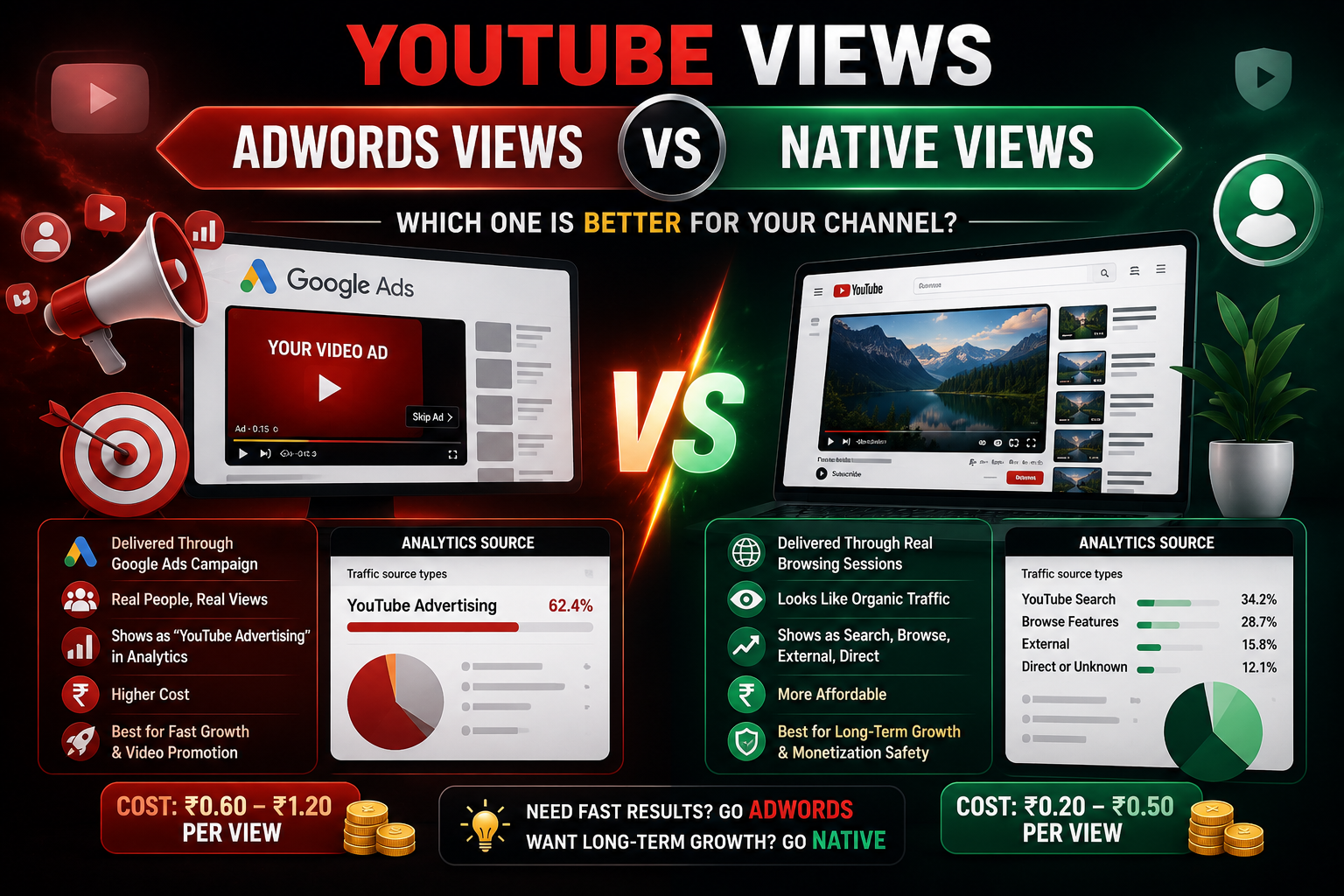
What AdWords views look like in your YouTube Analytics:In YouTube Studio → Analytics → Reach → Traffic Sources, AdWords views appear as "YouTube Advertising" or "Google Ads." This is completely normal and expected. Major music labels, large brands, and established creators all run YouTube ad campaigns and see this same traffic source in their analytics. It is not a flag or a problem — it is simply how paid advertising traffic is labeled.
What Are Native Views?
Native views, in the context of SMM panel services, refer to views delivered through real browsing sessions that simulate organic viewer behavior — not through an ad campaign.
Here is how these work: the panel directs real devices (phones, laptops, browsers) running actual YouTube sessions to watch your video. The viewing session originates from a regular YouTube browse — the viewer searches for content, navigates through YouTube, and watches your video as if they discovered it naturally. No ad is served, no advertising campaign is running.
Because the session originates from normal YouTube browsing behavior, native views show up in your analytics as organic traffic sources — typically "YouTube Search," "YouTube Browse Features," "External," or "Direct" depending on how the session is structured.
What native views look like in your YouTube Analytics:Native views blend into your regular organic traffic. In the traffic sources breakdown, you will see them contributing to "YouTube Search" or "Browse" traffic — exactly the same categories that your actual organic viewers generate. There is no separate "SMM Panel" category in YouTube Analytics. Native views and real organic views are analytically indistinguishable.
The Critical Difference: Algorithm Signals
This is where the comparison becomes important for your channel's long-term performance.
AdWords views — algorithm signal strength:AdWords views are genuine views from real people, but YouTube's algorithm treats them differently from organic views. Specifically, YouTube knows that a viewer who sees your video as an ad did not choose your content — it was placed in front of them. As a result, AdWords views have a lower weight in YouTube's recommendation algorithm compared to organic views.
The key metric here is Average View Duration (AVD). When someone sees a skippable ad, many viewers skip after 5 to 10 seconds. Even those who watch longer often do so passively rather than with the active engagement of someone who chose to click on your video from a recommendation. This means the AVD from an AdWords campaign is typically lower than the AVD from organic or native views.
Lower AVD from AdWords traffic signals to YouTube's recommendation algorithm that the video is not particularly engaging — which can slightly reduce how aggressively the algorithm recommends the video to organic audiences. For music videos and content where raw view count is the primary goal, this matters less. For creators who want the algorithm to push their content more broadly, it matters significantly.
Native views — algorithm signal strength:Native views are structured to look like organic viewer behavior. The session originates from a browsing context, the watch duration is calibrated to realistic retention rates (typically 40 to 70 percent of the video length), and the traffic source patterns match what a genuine viewer engagement would look like.
Because native views include realistic Average View Duration, they contribute more meaningfully to YouTube's ranking signals. Better AVD tells YouTube's algorithm that your content is engaging, which increases the likelihood of the video being recommended to additional organic audiences. A video that receives 1,000 native views with 50 percent average retention generates more algorithm momentum than 1,000 AdWords views with 15 percent average retention — even though the view count on the video looks identical.
Cost Comparison in Rupees
In the Indian SMM panel market, these two view types are priced quite differently because the underlying delivery cost structure is different.
AdWords views pricing:AdWords campaigns operate at scale. Because the views come from running actual Google Ads with real budgets, the cost is tied to the advertising cost-per-view on Google's network — which in India is relatively low compared to the USA or Europe. This is why AdWords views can be offered at very competitive rates, especially for large orders.
Typical Indian panel pricing for AdWords views:
- Small orders (up to 10,000 views): ₹150 to ₹200 per 1,000 views
- Popular packages (50,000 views): ₹57 to ₹65 per 1,000 views — approximately ₹3,000 for 50k
- Large orders (500,000+ views): ₹40 to ₹55 per 1,000 views
The per-unit cost decreases significantly with volume because larger advertising budgets get lower cost-per-view rates from Google. For high-volume orders — which is the norm for music video launches in the Punjabi and Hindi music industry — AdWords views are dramatically more affordable per view than native views.
Native views pricing:Native views cost more per view because real browsing sessions require more resources to operate than ad campaigns. Each native view involves a real device running a real browser session on YouTube, which is inherently more costly to execute than buying ad inventory.
Typical Indian panel pricing for native views:
- Standard packages: ₹150 to ₹250 per 1,000 views
- Indian-targeted native views: ₹200 to ₹350 per 1,000 views
- High-retention native views: ₹250 to ₹400 per 1,000 views
The price premium for native views reflects both the higher operational cost and the better algorithm signal quality per view.
When to Choose AdWords Views
Goal: Rapid view count for social proofIf your primary objective is building a visible view count number — for a new music video launch, a product announcement video, or a business channel trying to establish credibility — AdWords views are the right choice. You can reach 50,000 or 100,000 views far more cost-effectively than with native views, and the social proof effect of that view count is identical regardless of how the views were generated.
Goal: Punjabi or Hindi music video launchThis is the most common use case for AdWords views in India. The Punjabi music industry specifically relies on first-week view counts as a signal of commercial viability — for label deals, for playlist consideration, for brand interest. Getting a new song to 1 lakh views in its first week through an AdWords view campaign is a standard promotional strategy that Indian music panels offer specifically for this purpose.
TrueSMMPanel's most popular package for music releases is the 50,000 AdWords view package, which delivers rapidly and generates the launch momentum that music artists need during the critical first week after release.
Goal: Large volume at lowest cost per viewFor orders of 50,000 views or more, AdWords views are almost always the more cost-effective choice. The per-view rate drops significantly at scale in a way that native views simply cannot match, because native view delivery has a higher fixed cost regardless of volume.
Not ideal when:You want the algorithm to push your video to more organic viewers, or you are building watch hours specifically for monetization, or your video has low production quality that would generate poor retention even from real paid viewers.
When to Choose Native Views
Goal: Algorithm momentum and recommendation triggerIf you want the YouTube algorithm to notice your video and start pushing it to organic audiences, native views are significantly more effective than AdWords views. The realistic AVD from native views tells YouTube's ranking system that your content holds viewer attention — the signal that triggers broader recommendation distribution.
Goal: Watch hour accumulationFor Indian creators trying to reach the 4,000-hour YPP monetization threshold, native views are more valuable per view than AdWords views. A native view with 50 percent retention on a 15-minute video generates 7.5 minutes of watch time. An AdWords view with 20 percent retention on the same video generates only 3 minutes. For the same number of views, native delivery contributes more than double the watch hours toward your monetization threshold.
See our YouTube Watch Hours Panel if watch time accumulation is your primary goal — dedicated watch hour delivery is even more efficient than either view type for this specific purpose.
Goal: Indian-targeted audience geographyIndian-targeted native views specifically route viewing sessions through Indian IP addresses, ensuring your analytics show India as the primary viewer geography. This matters for regional language creators, for Indian brands with domestic target audiences, and for sponsorship credibility. AdWords campaigns can be geo-targeted but Indian geography is not always the default and requires careful campaign setup.
Goal: Blending seamlessly with your organic trafficIf your channel already has meaningful organic traffic and you want to boost a specific video without creating an obvious "YouTube Advertising" traffic spike in your analytics, native views are the better choice. They appear as organic traffic sources and blend naturally into your existing analytics picture.
The Combination Strategy: When to Use Both
For a serious video launch — particularly for music releases, major brand videos, or channel milestone videos — the most effective approach combines both view types in a specific sequence.
Days 1 to 3 after upload: AdWords views for rapid count building. Get from zero to your target social proof number quickly. The fast delivery signals that your video is gaining momentum, which helps with early sharing decisions from real viewers who see the view count.
Days 3 to 14 after upload: Native views for algorithm reinforcement. As the AdWords campaign delivers its volume, supplement with native high-retention views that improve your Average View Duration metric and give YouTube's algorithm stronger signals to recommend the video to organic audiences.
This sequence gives you both the visible social proof number AND the algorithm signal — the benefits of both types in a single coordinated campaign.
Frequently Asked Questions
Will AdWords views count toward my YouTube Partner Program 4,000-hour requirement?
Yes. AdWords views are real views from real people and count toward your watch time totals. However, because AdWords views typically have lower average retention than native views, they generate fewer watch hours per view. For dedicated watch time building, our YouTube Watch Hours Panel is more efficient.
Can YouTube penalize my channel for AdWords views?
No. AdWords views come from Google's own advertising network. YouTube cannot penalize a channel for having advertising traffic — that is the core of YouTube's own business model. Every channel that runs a YouTube ad campaign receives the same "YouTube Advertising" traffic source label.
Why do my YouTube Analytics show fewer views than my Google Ads campaign reports?
This is a well-documented discrepancy between Google Ads metrics and YouTube Analytics. Google Ads counts an "engaged view" when someone watches 30 seconds or more. YouTube Analytics counts a view when the video is loaded and begins playing. There is typically a lag of 24 to 72 hours before Google Ads views fully appear in YouTube Analytics, and the final count may differ slightly due to YouTube's own view validation process.
Do native views trigger subscriber growth?
Native views can contribute to organic subscriber growth if the viewer genuinely likes the content. However, dedicated subscriber growth is better addressed through a separate subscriber panel service rather than expected as a byproduct of views. See our full YouTube services page for subscriber options.
Which type is better for a new channel with zero views?
For a completely new video on a zero-view channel, starting with a modest native view order (500 to 1,000 views) is typically more effective than AdWords views, because the higher retention signals help the algorithm evaluate the video positively during its initial test phase. Once the video has established some organic traction, AdWords views can scale the count further if needed.
Ready to Order?
TrueSMMPanel offers both AdWords views and native views for Indian creators, with all orders accepted via UPI, Paytm, and major Indian payment methods — priced in rupees with no currency conversion.
👉 View Our YouTube Views SMM Panel — Current packages, pricing, and order form
Related Reading
- Cheap YouTube Views SMM Panel — Full overview of YouTube views services including AdWords and native options
- YouTube Watch Hours Panel — For watch time accumulation toward the 4,000-hour monetization threshold
- Cheap YouTube Views for Music Video India — Specifically for Punjabi, Hindi, and regional language music artists
- Why Your YouTube Video Gets 0 Views After Upload — Technical fixes before investing in any view service
Last updated July 2026. Google Ads pricing and YouTube algorithm behavior are subject to change. Verify current packages and pricing directly before ordering.