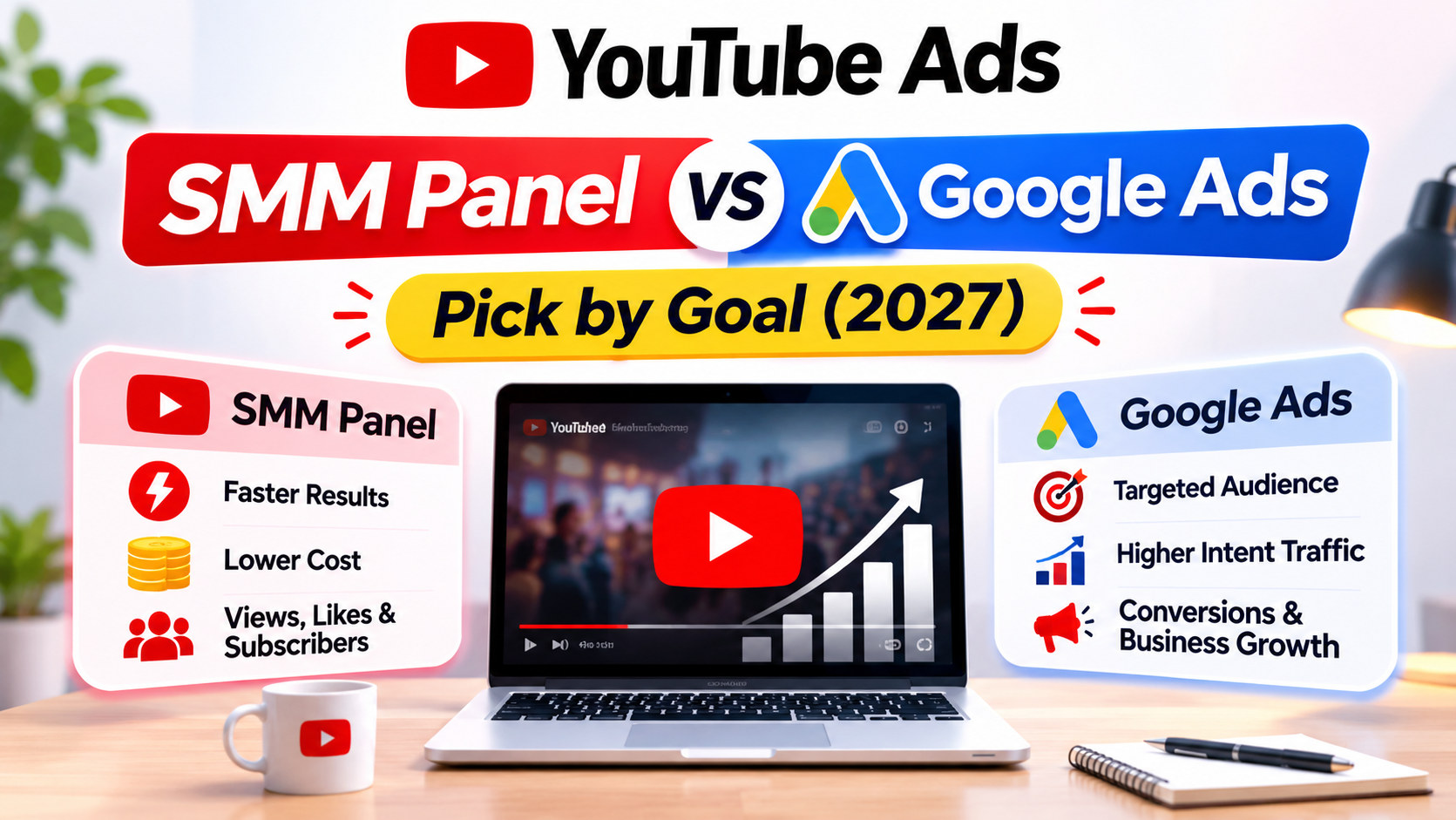
YouTube Ads SMM Panel vs Google Ads: Pick by Goal (2027)
Pick Google Ads if you want real people in a chosen audience to watch, subscribe, visit your site or buy. Pick a YouTube ads SMM panel only if your goal is to change how a page looks, such as adding early views or likes before a launch, and you accept the policy risk. For leads, sales and long-term channel growth, Google Ads wins. For quick visual numbers at low cost, a panel is faster.
Two tools that get confused
A “YouTube ads SMM panel” is an SMM panel that sells YouTube services, sometimes under names like “ads views” or “promotion views”. Google Ads is Google’s own advertising platform, where YouTube video ads are created and paid for.
They both make a view counter go up, which is why people compare them. But they reach the counter in different ways, and that changes what you can expect afterwards. The best way to choose is to start from your goal and work backwards.
The decision table
Your goal
Better choice
Why
Real viewers in a city, age group or interest
Google Ads
Targeting by location, age, interest and keyword
Website visits or enquiries
Google Ads
Clickable call-to-action and conversion tracking
Online sales
Google Ads
Remarketing and conversion bidding
Subscribers who keep watching
Google Ads, plus good content
Viewers chose to watch your video
A launch video that does not look empty
SMM panel, small and drip-fed
Fast visible numbers at low cost
Testing which thumbnail real viewers prefer
Google Ads
Real click data on equal audiences
Meeting YouTube Partner Program thresholds
Neither as a shortcut
YouTube reviews channels for real activity
Reselling services to your own clients
SMM panel with API
Bulk pricing and automated orders
If your goal sits in the top half of the table, a panel cannot do the job no matter how cheap it is.
Goal 1: Reach a specific audience
Say you run an IELTS coaching centre in Ahmedabad. You want students aged 18 to 26 within 30 km to see your free demo class video.
With Google Ads, you set exactly that: location, age, and interests like study abroad. You can add keywords such as “IELTS preparation” so the ad appears near related videos. Every view comes from someone in that group.
With a panel, you choose a quantity. You do not choose the city, age or interest of the viewers, so the views do not reach the students you need. Some panels offer country targeting, such as “India views”, but that is far broader than a city or an interest. [CONFIRM: geo-targeted services]
Winner: Google Ads.
Goal 2: Get leads or sales
Google Ads lets you add a call-to-action button, send viewers to a landing page and track form fills or purchases as conversions. You can then let Google bid for more of the people likely to convert.
Panel views do not click through to your website in a way you can count as leads. A video with 50,000 panel views and no conversion tracking tells you nothing about sales.
Winner: Google Ads.
Goal 3: Social proof on a new video
This is the case people buy panel services for. A brand uploads a product video at 10 am and plans to share it with 40,000 email subscribers at 5 pm. The marketing lead does not want the video sitting at 14 views when those subscribers arrive.
A small panel order of views and likes, drip-fed over the day, makes the page look active. It is fast and cheap. For example, at a hypothetical ₹80 per 1,000 views, 3,000 views costs ₹240.
The trade-off is policy risk. YouTube’s fake engagement policy prohibits artificially inflating metrics, and YouTube can remove views or act against content that breaks it. You can get a similar effect without that risk by running Google Ads for a few hours before the email goes out.
Winner: Panel for speed and cost; Google Ads for safety.
Goal 4: Channel growth and subscribers
YouTube recommends videos based on how real viewers respond: whether they click, how long they watch and whether they come back. Google Ads views come from real people, so a strong video can earn subscribers and watch time that keeps paying off.
Panel subscribers and views come from accounts that are not your audience. They do not watch your next upload. Over time, a channel full of these accounts shows weak engagement per subscriber, which makes growth harder to read and plan.
Winner: Google Ads, with content that earns the click.
Goal 5: Monetization
The YouTube Partner Program opens fan funding at 500 subscribers, 3 public uploads in 90 days and 3,000 watch hours in 12 months (or 3 million Shorts views in 90 days). Ad revenue sharing needs 1,000 subscribers and 4,000 watch hours (or 10 million Shorts views in 90 days).
YouTube reviews channels before approval. Bought subscribers and watch hours do not help you pass that review and can lead to rejection. Ads can help real people find your channel, but the safest route to monetization is consistent uploads that real viewers watch.
Winner: Neither as a shortcut.
Goal 6: Reselling to clients
If you run an SMM reseller business, your product is panel services. You need bulk pricing, stable service IDs and an API that lets your own website place orders. Google Ads does not fit this model.
Truesmmpanel supports resellers through [CONFIRM: API available] and [CONFIRM: bulk or reseller pricing]. Tell your clients plainly what each service does, including YouTube’s rules, so you avoid disputes later.
Winner: SMM panel.
Cost compared side by side
Here is a hypothetical comparison for 10,000 views on one video:
Google Ads
SMM panel
Typical planning cost
₹4,000 to ₹8,000 at ₹0.40 to ₹0.80 per view
₹600 to ₹1,500 at ₹60 to ₹150 per 1,000
Viewers you choose
Yes
No
Watch time from your audience
Yes
No
Leads or sales tracked
Yes
No
Policy risk
Low when ads follow Google’s ad policies
Fake engagement policy applies
The panel is cheaper per view. Google Ads is cheaper per result, because panel views rarely produce subscribers who stay, leads or sales.
Can you use both?
Yes, as long as you keep their roles clear. A common structure is:
- Use Google Ads as the main campaign, with tight targeting.
- If you use a panel, place a small drip-fed order only on launch day.
- Report results using real metrics: watch time from ads, subscribers from ads, clicks and conversions.
Never let panel numbers become the result you report to a boss or a client. They describe the page, not the audience.
Three buyers, three decisions
The decision table is easier to apply when you see it on real situations. These three are hypothetical but typical.
A Surat textile wholesaler
Goal: enquiries from boutique owners in Gujarat, Maharashtra and Rajasthan for a new saree collection.
Choice: Google Ads. The wholesaler targets those three states, adds interests related to fashion retail and runs a 45-second catalogue video with a WhatsApp click-to-chat button. A panel would add views from people who will never place a wholesale order.
What to track: WhatsApp chats started from the ad and orders placed in the next 30 days.
A Bengaluru tech reviewer with 3,000 subscribers
Goal: more subscribers who watch every upload.
Choice: Google Ads on the channel’s best-performing review, plus Shorts linking to it. The reviewer watches cost per subscriber and checks that new subscribers watch the next upload. Panel subscribers would raise the count but drag down views per subscriber, which brand sponsors look at closely.
What to track: subscribers from ads, views on the next upload in the first 48 hours.
A Delhi SMM reseller
Goal: fulfil YouTube orders for 40 small clients every month.
Choice: an SMM panel with an API. Google Ads does not fit a business that sells engagement services. The reseller tests each service, keeps a short menu and explains YouTube’s rules to clients before they order.
What to track: delivery time, drop rate after 30 days and refill requests per service.
Questions to ask yourself before you spend
If you are still unsure which tool fits, answer these five questions honestly:
- Who do I need to reach? If you can name the city, age or interest, you need targeting, so use Google Ads.
- What should happen after they watch? If the answer is a click, a call, a sign-up or a sale, use Google Ads.
- Will anyone read my analytics? If a client, boss or sponsor will, keep panel use small and report it separately.
- How much risk can the channel take? If the channel is central to your business, avoid services that break YouTube’s rules.
- Am I selling engagement as a product? If yes, a panel with an API is your supplier.
Most buyers answer the first two questions and have their decision.
Frequently Asked Questions
1. What is a YouTube ads SMM panel?
It is an SMM panel that sells YouTube engagement services, such as views and likes, sometimes labelled as “ads” or “promotion” views. It is not the same as Google Ads.
2. Is a YouTube ads SMM panel cheaper than Google Ads?
Per view, usually yes. Per real result, such as a subscriber who stays or a lead, Google Ads is usually cheaper.
3. Which is better for a small business?
Google Ads, because you can target local customers and track enquiries. A panel cannot target a city or interest group.
4. Can an SMM panel target viewers in my city?
Most panels cannot target by city. Some offer country-level services. Google Ads can target by city, radius, age and interests.
5. Is buying panel views against YouTube’s rules?
YouTube’s fake engagement policy prohibits artificially inflating views, likes, comments or subscribers. Panel services fall under that policy.
6. Will Google Ads help me get monetized?
Ads can help real viewers find your channel. YouTube still reviews every channel, so focus on content that real viewers watch.
7. What should I choose for a launch video?
Google Ads for reach. If you add panel support, keep it small and drip-fed so it does not distort your data.
8. How fast do panel views arrive compared with ads?
Panel orders often start within hours. Google Ads campaigns can start serving within a day once the ad is reviewed.
9. Can resellers use Google Ads instead of a panel?
Resellers sell panel services, so they need a panel with an API. Google Ads suits businesses promoting their own videos.
10. How do I measure success for each option?
For Google Ads, track cost per view, watch time, subscribers, clicks and conversions. For panel orders, check delivery and drop rate, and do not treat them as audience results.