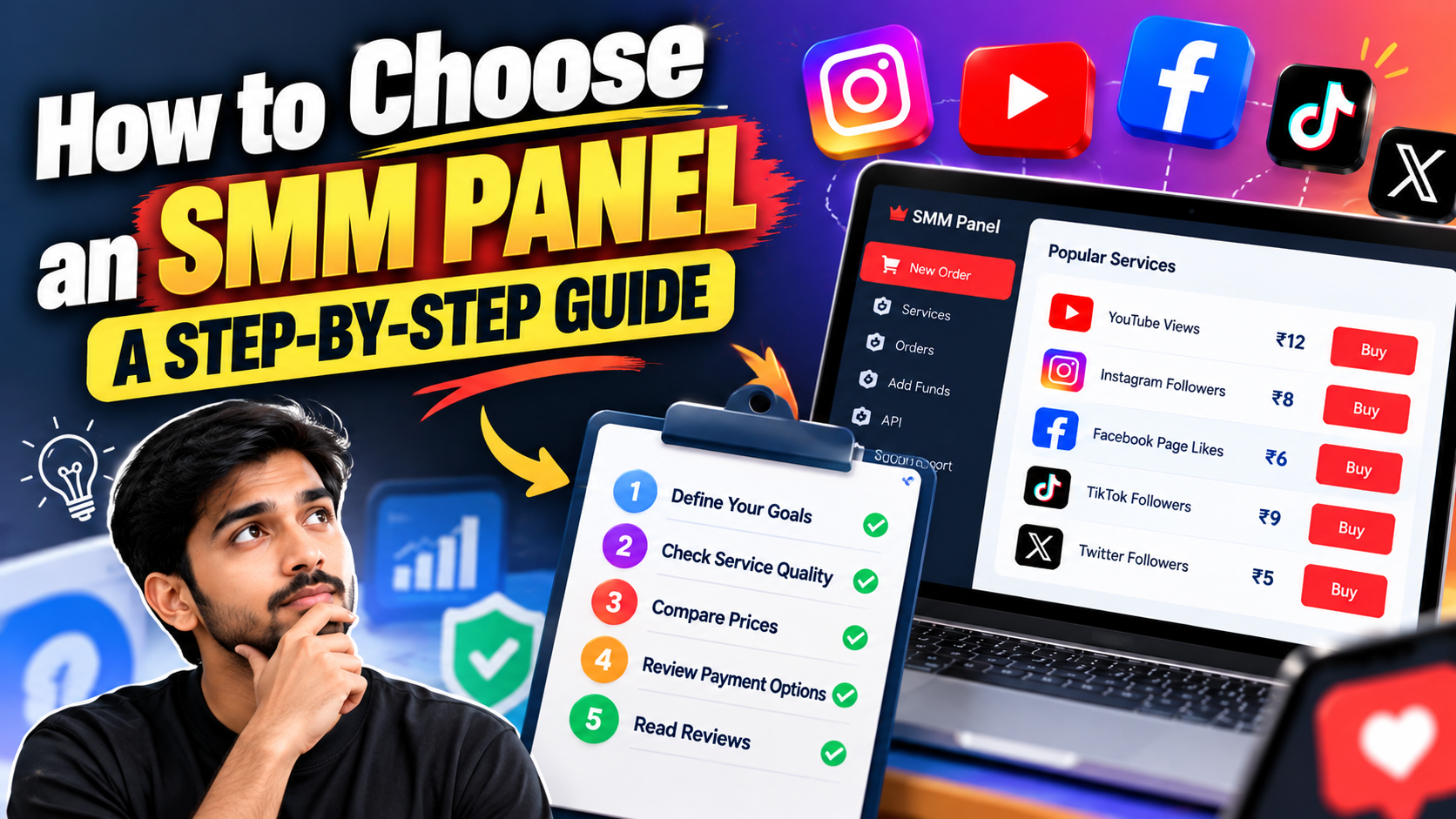
How to Choose an SMM Panel: A Step-by-Step Guide
Entering the market of bulk social media services can feel overwhelming for a beginner. The internet is flooded with identical dashboards claiming to offer the fastest delivery and the cheapest prices. If you select a provider based entirely on homepage marketing, you risk wasting your budget on inactive services or exposing your social media accounts to security threats. You need a structured approach to filter out unreliable vendors. This guide provides a clear process for evaluating providers. You will learn how to identify common red flags, what specific questions to ask customer support before depositing funds, and how to execute a controlled test order.
Featured answerTo choose an SMM panel safely, beginners should start by comparing service transparency, not just price. You must verify that the dashboard publishes clear delivery data, explicit drop rates and functional refill policies. Always contact customer support with specific technical questions and place a minimum test order before committing a larger budget.
Step 1: Define Your Goal and Platform Needs
Before you create an account anywhere, you must define exactly what you are trying to achieve. Different providers specialise in different networks. A dashboard that delivers excellent video metrics might struggle to maintain stable channel subscriptions.
First, check whether the panel provides the services you actually need. A provider with a wide range of services can be more convenient if you manage multiple social media platforms. However, a panel advertising thousands of services is not necessarily better. Large catalogues often contain broken or obsolete listings imported from a single supplier. You should look for a catalogue that tells you which services are actually working.
Step 2: Evaluate the SMM Panel Pricing Mechanics
Pricing is an important factor when choosing an SMM panel. However, choosing the cheapest option immediately is a mistake. Different providers charge different rates based on service quality, delivery speed and retention guarantees.
You must compare the price alongside the specific service description. A cheap service often indicates low-quality bot accounts that platforms delete rapidly. If you buy 1,000 units for ₹10 but 900 drop within two days, your money is wasted. A service priced at ₹30 that includes a 30-day refill guarantee is mathematically cheaper because the units remain on your profile. Always calculate the cost per retained unit rather than looking blindly at the upfront dashboard price.
Step 3: Read the Refill and Refund Policies
Orders fail frequently in this industry. Social media platforms constantly update their security filters, which causes third-party delivery networks to stall. You must know what happens to your money when a service stops working.
Check if the panel offers automatic refunds for partial orders, or if you have to request them manually. You should also verify if cancellation works directly through the dashboard interface or if it requires a support ticket. Furthermore, you must read the terms regarding failed deposits. Most platforms return failed order funds to your internal panel balance rather than your bank account [CONFIRM REFILL AND REFUND TERMS].
Step 4: Identify Beginner Red Flags
Several warning signs indicate a provider is unreliable or operating a scam. If you spot any of these red flags, close the website.
- Requests for Passwords: A legitimate SMM panel only requires the public URL of your social media post or profile. If a platform asks for your login credentials, it is a security threat.
- Guaranteed 100% Algorithmic Safety: No automated service is immune to platform updates. Trustworthy panels admit that drop rates exist.
- Vague Service Descriptions: If a service is listed as "High Quality Followers" with no details regarding start times, delivery speed or drop expectations, the provider is hiding the true nature of the service.
- No Contact Information: If the only way to reach support is a generic email form with no expected response time, you will struggle to get help when an order fails.
Step 5: Test Customer Support (Questions to Ask)
Customer support is a major indicator of reliability. You should test the support team before you add any funds. Send a message via live chat, WhatsApp or their ticket system to see how quickly and clearly they answer.
Ask these specific questions to gauge their operational competence:
- "Which specific service ID do you recommend for an account looking for drip-feed delivery?"
- "If an order stalls at 50% completion, do you refund the remaining amount automatically?"
- "How long does it typically take your team to process a manual refill request?"
- "Are your payment gateway fees included in the listed deposit amount, or are they added at checkout?"
A professional provider will answer these technical questions directly. If they respond with generic marketing statements, you should look elsewhere.
Step 6: Run a Safe Test Order
Never commit a massive budget to an untested platform. You must verify the panel's quality and retention firsthand.
The safest way to evaluate a provider is to place a minimum order, usually costing a few rupees, on a service you do not care about.
- Check the available payment options and ensure the payment process clearly explains how transactions are handled.
- Deposit the absolute minimum amount allowed by the gateway [CONFIRM MINIMUM ORDER].
- Select a service and input a URL for a secondary, disposable account.
- Check the order tracking dashboard to see how quickly the status updates.
- Monitor the test account after 24 hours and again after a week to measure the exact drop rate.
When Using a Panel Is Not Appropriate
Beginners often mistakenly believe that purchasing metrics will instantly make them an influencer or attract brand deals. This is false. You should not use a panel if your goal is to build genuine customer relationships or secure direct sales. The accounts interacting with your profile are automated networks. They do not have credit cards, they do not click affiliate links, and they will never buy your products.
Furthermore, you must avoid using these services if you plan to apply for official monetization programs. Platforms rigorously audit profiles before approving them for ad revenue sharing. They easily detect histories of artificial engagement and will reject your application.
Legitimate Alternatives for Social Media Growth
If you want sustainable, risk-free growth, you must rely on organic strategies or official advertising channels.
Focus on search engine optimization by using accurate keywords, detailed descriptions and relevant tags in your content. This helps the platform algorithms categorize your work and display it to genuine users actively searching for those topics.
If you have a budget, use the official advertising platforms provided by Meta, YouTube or TikTok. Running legitimate ad campaigns guarantees your content is served to real human users within the boundaries of platform policies, allowing you to build an authentic audience over time.
Where TrueSMMPanel Fits
TrueSMMPanel is a platform where users can browse services for Instagram, YouTube, TikTok, Telegram and Facebook. You must sign up to access the dashboard, where you can view pricing before placing an order. The system includes a mass order feature and allows you to track your status directly. Delivery times depend entirely on the selected service ID. TrueSMMPanel provides an API for developers and offers support via Telegram and WhatsApp. The platform supports several payment methods and clearly states that you should never share your social media passwords.
Frequently Asked Questions
What is the first thing I should check when choosing an SMM panel?
You should check the transparency of the service descriptions. Ensure the provider lists specific details such as expected start times, average delivery speeds and clear refill terms for each individual service ID.
Why should I avoid the absolute cheapest SMM services?
The cheapest services usually employ low-quality bot accounts that social media platforms detect and remove almost immediately. You will lose the metrics you paid for and damage your account standing in the process.
How do I know if an SMM panel is secure?
A secure panel uses standard web encryption for payment processing and clearly outlines its data protection policies. Most importantly, a legitimate panel will never ask for your social media account passwords.
Should I test a panel before making a large deposit?
Yes. You should always deposit the minimum required amount and place a small test order using a secondary account. This allows you to evaluate the delivery speed and drop rate safely.
What questions should I ask customer support before buying?
Ask them about their specific refund policies for stalled orders, how long manual refill requests take to process, and which service IDs they recommend for natural-looking, drip-feed delivery.
Do all panels offer automatic refunds for failed orders?
No. Refund processes vary strictly by the provider. Some panels automate partial refunds, while others require you to submit a manual support ticket. Always read the panel refund policy [CONFIRM REFILL AND REFUND TERMS] beforehand.
Is it normal for a panel to have thousands of services?
Yes, but a high service count does not guarantee quality. Many panels import massive lists from single suppliers, resulting in broken or outdated listings. It is better to choose a panel with clear, functional options.
What is a drop rate and why does it matter?
A drop rate is the percentage of delivered metrics that disappear over time as platforms delete automated accounts. Calculating the drop rate helps you understand the true cost of retained engagement.
Can using an SMM panel ruin my chances of monetization?
Yes. Social media platforms strictly prohibit artificial engagement. If an audit detects that you inflated your metrics using a panel, your application for official monetization will be rejected.